Showing posts with label history. Show all posts

Thursday, 31 January 2013

Mural made of stamps at NMA


Hey internet! I accidentally didn't manage to do an Australia Day post over the weekend... was distracted by other things. But as I was surfing the net a little while ago I came across these awesome murals made out of stamps! Yep, wicked!

These Flag murals made of stamps are held at the National Museum of Australia and are pretty fun. They are Aussie in theme, so they kind of tie in with the Australia Day long weekend we just enjoyed.


Through the NMA website you can zoom in and get a good look at the individual stamps that make up the collages. They are pretty ace! I have so many spare stamps, but I don't think I have the time or the patience to put something like this together.

Celebrating Australia Day is somewhat fraught, which is part of the reason why I didn't do a themed post at the time. I don't myself refer to it as Invasion Day, but I certainly respect that some people do. But anyhow, it seemed like the right time to share these little pieces of Australiana with you. The murals were made by Alban Watkins to mark the Australian Bicentenary in 1988.

Also, I have a hot date at the museum tonight (not bragging or anything... ok I am totally bragging), so it made sense to post something museum related. I am off to the Melbourne museum, not the National Museum, so I probably won't see stamps. But it should be fun.

Anyhow, check out the Flag murals made of stamps, they form part of an online exhibition which you can access here.  Enjoy!

Wednesday, 24 October 2012

Postcards from the Past: Archaeology and Family


In my last blog post on Sunday I mentioned that I had a massive week last week. As it turns out the above postcard represents a synergy of all that massive week contained! Let me explain...

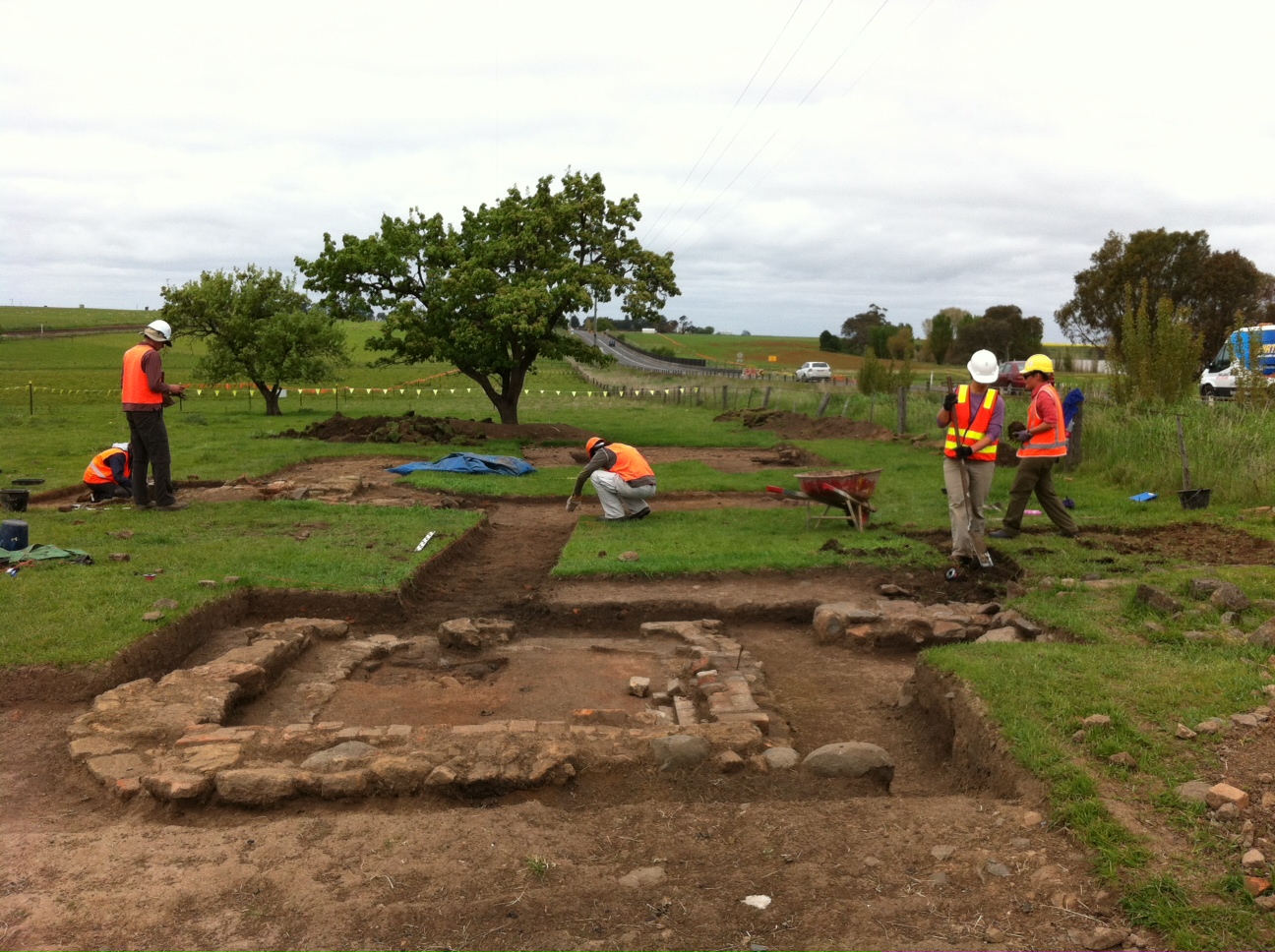
My working week was massive, because I was taking part in another fieldwork session out past Ballarat on an old gold-rush era site (I blogged about it back in July here). It was our very last week of fieldwork last week, and we all felt like we were the stars of 'Time Team', with Tony Robinson in voice over saying something  along the lines of
"with only five days before this site is bull-dozed to make way for a new freeway, the archaeologists are working against the clock to find out what they can of this fascinating microcosm of life on the road to the goldfields in the 1860s..." 
There is a little bit of dramatic-license in there, but you get the drift. We were on a schedule. A road is being built. We worked like maniacs. Tony Robinson may or may not have been there. Here are some happy snaps:


It was a very fun week, and the archaeology was pretty interesting. Will found a coin from 1835, a pocket knife and a jet earring. Rach found an ink well. Ben found a bottle of some magical ointment that was a cure-all for gout, rheumatism and sore breasts! And I found some broken ceramics. Oh, and a sewing pin, when it pricked me in the finger. Dang! But what a fun week we had. Massively exhausting, but great fun.

Then, on Saturday, I turned around and drove back from whence I came, to Ballarat, in order to trawl through my Grandparents possessions, as they have just sold the family home. That was a massive day for all sorts of reasons. It is so sad to see the house go, as it has been in the family for generations. I loved spending all my school holidays there as a kid, playing in the garden with my cousins and sisters. My sister Emily got married in that garden a couple of years ago, and so the house holds all sorts of special memories. Here are some happy snaps of the house and garden "Glenholme":


My Grandma gave me her stamp collection, but I also took another special item of 'post' from the house... Great-Great-Great Aunty Mabel's postcard collection. There will be many more blog posts about Mabel's postcards, because they are so wonderful. She collected her postcards are from such exotic places as Ceylon, Zimbabwe, Norway and Hong Kong. The lady knew how to travel.

But as I was reading through them last night, I was super delighted to find the postcard from much closer to home, which I began this blog post with. This is a postcard Mabel received in 1905 from a party taking a picnic in an old 'Cobb and Co' coach right near the archaeological site I had spent my week digging up. So past and present, archaeology and memory, work and family life all meld together in the image on the front of the postcard, and the message scrawled to Mrs Cuthbert of Glenholme on the back. How absolutely lovely, and how absolutely thrilled I am.

Wednesday, 10 October 2012

Swedish treats: Forstadagsbrev Part 1


Last week I bought a desk. A beautiful wooden desk with seven drawers to hide all my stuff in. As a result, I spent the weekend finally unpacking the last box from my move to North Fitzroy... which happened four months ago!

Anyhow, as I was unpacking said box, I found these wonderful first day covers that my parents brought back from their trip to Sweden earlier this year. As they gave them to me just as I was moving, I put them in this box and promptly forgot all about their very existence. So, boy was I delighted when I found them the other day. This first one is my favourite, for three very good reasons:


             1) Map Postmark
             2) Viking ship stamps
             3) Map and flag illustration on envelope.

There is not much more you can ask for, in a first day cover, really. And this particular cover taught me the Swedish for first day cover:
              FORSTADAGSBREV

I like the ring of it.


Now, I have always been partial to Vikings, but I am especially more so since watching the entire series 1 - 5 of True Blood over the course of the past two months... Those of you who have seen it will hear what I am saying, but basically, Eric Northman makes me want to move to Sweden. Anyhow, all desire for undead Viking Vampires aside, you have to admit the woodcut design viking ships featured on the stamp are pretty special.

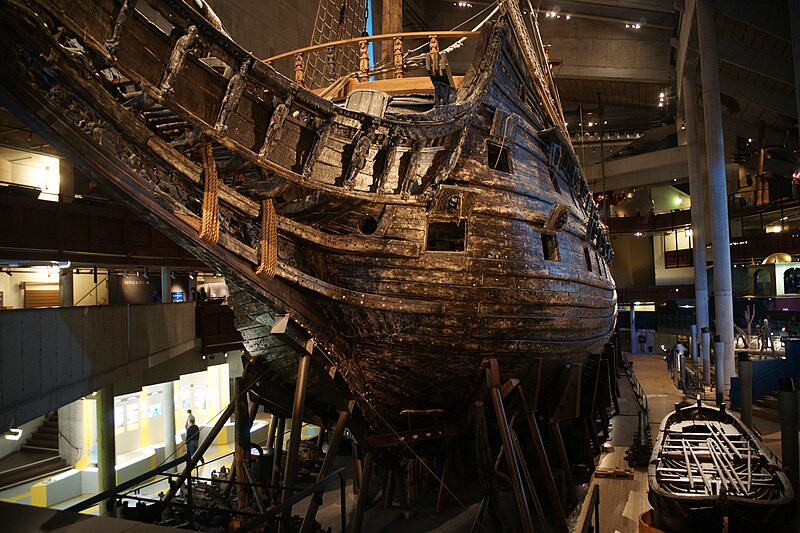
And speaking of ships, this next cover features the Vasa, sunk in 1628 and now housed in a museum in Stockholm.
The FDC
File:The Vasa from the Bow.jpg
The ship in the museum
The Vasa is a war ship from the time in the 17th century when the Swedes were a force to be reckoned with, and had acquired power over much of the Baltic area. In 1961 the shipwreck was salvaged, and the stamps feature some of the different sculptures that would have adorned the ship.

I visited the museum in Stockholm that houses the Vasa in 2006, and I have to say that it was one of the highlights of my stay in the city. Not only is the Vasa fascinating because it represents a time in history when Sweden was an imperial power and because the ship is almost a microcosm of society, but the thought of the archaeology of an underwater salvage is enough to float my boat (sorry! I couldn't help it!).  The pamphlet that comes with the FDC (issued in 1969) states "the restoration of the ship continues - a puzzle with more than 10,000 pieces." And that right there, my friends, is why I love archaeology!

Since I have actually been to see the ship featured on the stamp, I am doubly pleased that Mum and Dad picked this one out as a souvenir to bring back for me. It is pretty great, you have to agree.

There is one last FDC that I am going to share with you now from my little Swedish collection, just because I think it is beautiful:

The stamps on this last cover illustrate scenes from the Arctic Circle, in northern Sweden, where on the summer solstice the sun is above the horizon for 24 hours.

The one showing the Northern Lights is my favourite of the group... and it has taught me yet more Swedish: 
NORRSKENS FORSKNING
The Northern Lights - totally up there on my list of things/places that I simply must see before I die.

Thanks for tuning into I heart post for another week... and watch this space for still more Swedish delights in Part II of this post, which I will be uploading on Sunday. Until then, keep it real, nerds and hipsters. Over and Out. H.

Wednesday, 8 August 2012

You Can Telephone All Over the World


I had another go at creating a collage card this weekend, and the above was the result. It was made using a 1960s editions of National Geographic with an advertising slogan from a 1964 edition - "You can telephone all over the world" underlined by a much more recent satellite image. But what a quaint slogan! So anachronistic in today's world. But it got me thinking.


Ross Coulter
Ross Coulter,  10 000 Paper Planes - Aftermath via Centre for Contemporary Photography
On the weekend I went to this wonderful exhibition at the Centre for Contemporary Photography and heard several artists talk about their work. One of the artists was Ross Coulter, and his photographs depicted the aftermath of a performance art piece involving 10,000 paper planes being launched into the domed reading room at the State Library of Victoria. Now, for starters, the domed reading room is one of my favourite places. But, more than that, I loved Coulter's photographs because there was something incredibly compelling about the inherent rebellion in 10,000 paper planes being strewn across that hallowed space reserved for hushed tones and studious concentration. The photographs are big (156 x 200cm), glossy and wonderful.

Coulter explained during his floor talk that he worked at the SLV in 1999, right at that time when email was transforming the way we communicate with one another. The computer age was dawning, and Coulter described the paper planes as, in a way, symbolising the transmission of an idea through space. He was also asking a question about the role of libraries into the future, as we move from the analogue past into the digital future.

When I came across the Bell Telephone Company's 1964 slogan "You can telephone all over the world" that night after hearing Coulter's talk, it made me think of the cutting edge of communication - an international telephone call was a big deal in the sixties; and we were still adjusting to sending emails in the 1990s. How times have changed! Which is exactly what Australia Post was trying to capture in their "Then and Now" stamp release from earlier this year.


Actually, I think the stamps are a little ugly.  Despite the fact I have strict (ok, lax) rules about not collecting ugly stamps, I had to have them, because they had a cool gutter strip (and I love a good gutter strip). But really, the best way to find out about the "then" (as opposed to the "now") is to go directly to the source by looking at stamps issued at the time. So check out this fantastic stamp from 1985 visualising Electronic Mail:


Don't those triangles resemble Coulter's paper planes zooming through the aether, though his had landed and these are mid flight? It is such a space age image. I love it. So that is how Electronic Mail was imagined in 1985. 1985! Very cutting edge.

Could Australia Post have possibly imagined the transformative nature of e-mail for their industry at that point in time? I don't think so. I think at that point Australia Post might have presumed that they would be delivering, in some capacity, those electronic mails, and this 1985 stamp was advertising that futuristic hope.

So, as we ponder the roles of libraries and postal services as technology races ahead into the future, I think (and hope), for the time being at least, there are enough bibliophiles and philatelists (read: nerds) to keep these historic and vital institutions alive. And we can only imagine what people in thirty years might think of our communication practices today! Maybe our dependence on emails will be laughably quaint. Who knows?? Lets just hope that there are still postage stamps for us to gaze at, decipher and treasure.

Wednesday, 18 July 2012

Archaeology / Gold Rush / Stamps / Yay!


On site at Burrumbeet. The big skies out there are amazing.
Howdy folks!
The past two weeks I have been away on fieldwork, hanging out with the archaeologists and digging up what was an old hotel on the busy road between two goldfields in the 1850s and 60s. It was a really great two weeks and we uncovered what is a really interesting site, which is indicative of a bustling little township in a place that is now the home to only a handful of people.

Text from my stamps presentation pack

Gold was officially discovered in 1851 - and then it was on like donkey kong. People poured into the colony. Men mostly, but from all corners of the globe. The gold-rush era transformed the fledgling colony of Victoria - only newly separated from New South Wales - and as a result of this new found wealth, roads were built; railways established; and not a few hotelkeepers made their fortunes rather cleverly, not by seeking gold, but by selling grog to those who were.

Of course, you will all be pleased to know, the gold rush, which had such a momentous and lasting impact on the colony and on the country, has been commemorated in a stamp issue (everything comes back to the stamps!)


The stamp designs are based on the drawings of artist ST Gill and depict life on the gold fields, which was a very hard slog that didn't necessarily result in a large payday.


The site that we were working on the past two weeks was about a days journey between two goldfields; and therefore a perfect resting place, so many hotels and grog shops sprung up. Judging by the misty mornings we encountered, it would have been damn cold on them goldfields sleeping under a canvas tent.

So, here are a few happy snaps from our time on site. It was such great fun.

Stringing up a new trench on a very misty morning.
Uncovering a bluestone wall: foundations of a pub?
Heads down, bums up: getting deeper into the trench

 Wendy & I on another very misty (cold) morning. We wouldn't have been able to see each other but for our hi-vis!
The hotel site is really intriguing, and we still have more work to do out there. The gold era catches my imagination and I love it! Yay for archaeology and history and post all coming together into my life! What a great couple of weeks!

Sunday, 15 July 2012

Flags: Sunday Stamps


Wow! Due to the general business of life it has been more than two weeks without blogging - in fact I haven't blogged at all this month - and I am seriously suffering withdrawal symptoms!! (One of the symptoms included rocking up to small soiree with a bottle of wine in one hand, and my stamps in the other - and a polite request to use the host's scanner before the other guests arrived. Thanks Ben!)

Anyhow, needless to say I am very excited about participating in this week's Sunday Stamps. The theme is national flags; inspired partly by the fact that it was Bastille Day during the week. And within my collection, I found the perfect stamp for the theme, which has the French flag behind three figures of Liberty, Equality and Fraternity and commemorates the French Revolution, but is in fact an issue from the USA:

It is hard to tell from the scan of course, but part of the appeal of this stamp is its size - it is about double the size of a standard stamp. A nice stamp, yes?

Of course, there are plenty of stamps featuring the Australian flag in my collection, so I thought I better share one of them too. I like this one because it has a bit of a tech-y computer-chip thing going on, to make it more interesting.
The Australian flag features the Union Jack, the seven pointed star representing the Commonwealth, and the southern cross.

I also started pondering alternative Australian flags, and hoped that I would be able to share a stamp featuring the Aboriginal flag - but alas, there doesn't seem to be one in existence. This is a bit sad, in my view. I think Australia Post should rectify that, quick stat.

File:Australian Aboriginal Flag.svg

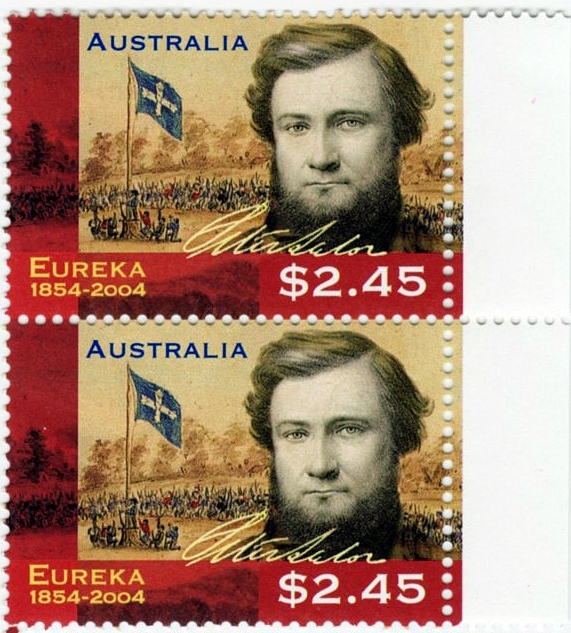
The other alternative flag I thought about was the Eureka flag. The Eureka Flag, which pre-dates our national flag, also features the southern cross, and was born out of a miners strike on the Ballarat goldfields in 1854. The flag is now used by the Workers Union movement. The Eureka flag has been chosen by Australia Post to feature on a stamp, and I have a mint pair. I really like that the image features a rippled fabric effect.

Peter Lalor, the rebel leader at the Eureka Stockade, standing beneath the Eureka flag, swore the first oath to a non-British flag on Australian soil. He said:
"We swear by the southern cross to stand truly by each other and fight to defend our rights and liberties."
The gold diggers at Ballarat were fighting their own revolution against an unjust licensing system and a corrupt administration. And in a way, Lalor's oath ties in nicely with the mantra of the French Revolution, taking us back to our starting point: Liberty, Equality, Fraternity.


Thanks for joining me once again for Sunday Stamps, please click on the link to find out what other bloggers have been pondering in relation to flags and stamps.